Three products, one word
Metal is a material, not a product category, and the print-on-demand market uses the word for at least three unrelated things. They have different economics, different customers and different failure modes.
| Route | What it physically is | Best suited to |
|---|---|---|
| Printed metal panels | Your image dye-sublimated onto a flat coated aluminium sheet. A photographic print with a metal substrate — a rectangle, edge to edge. | Photography, illustration, full-colour artwork. Anything where the image is the product. |
| Display plates and licensed poster plates | Mass-produced printed metal panels sold through platforms with their own catalogue and brand, usually with a magnetic mount. | Sellers who want a marketplace to handle everything, and are willing to work inside its catalogue and its branding. |
| Laser-cut steel | Steel sheet cut to the outline of the artwork itself, powder coated in a solid colour. Not a rectangle — the negative space is the wall behind it. | Silhouettes, line work, typography, geometric and architectural designs. Anything that reads as a shape rather than a picture. |
None of these is better in the abstract. They are answers to different design problems — a photograph cannot be laser cut, and a silhouette loses most of its effect printed on a rectangle.
What the large POD networks do and do not cover
The big fulfilment networks — the ones already wired into Etsy and Shopify — are built around printing. Their metal offering is printed aluminium, and it is genuinely good at what it does: a wide print catalogue, automated order sync, established shipping. If your artwork is a full-colour image, that is very likely the right route and you do not need us.
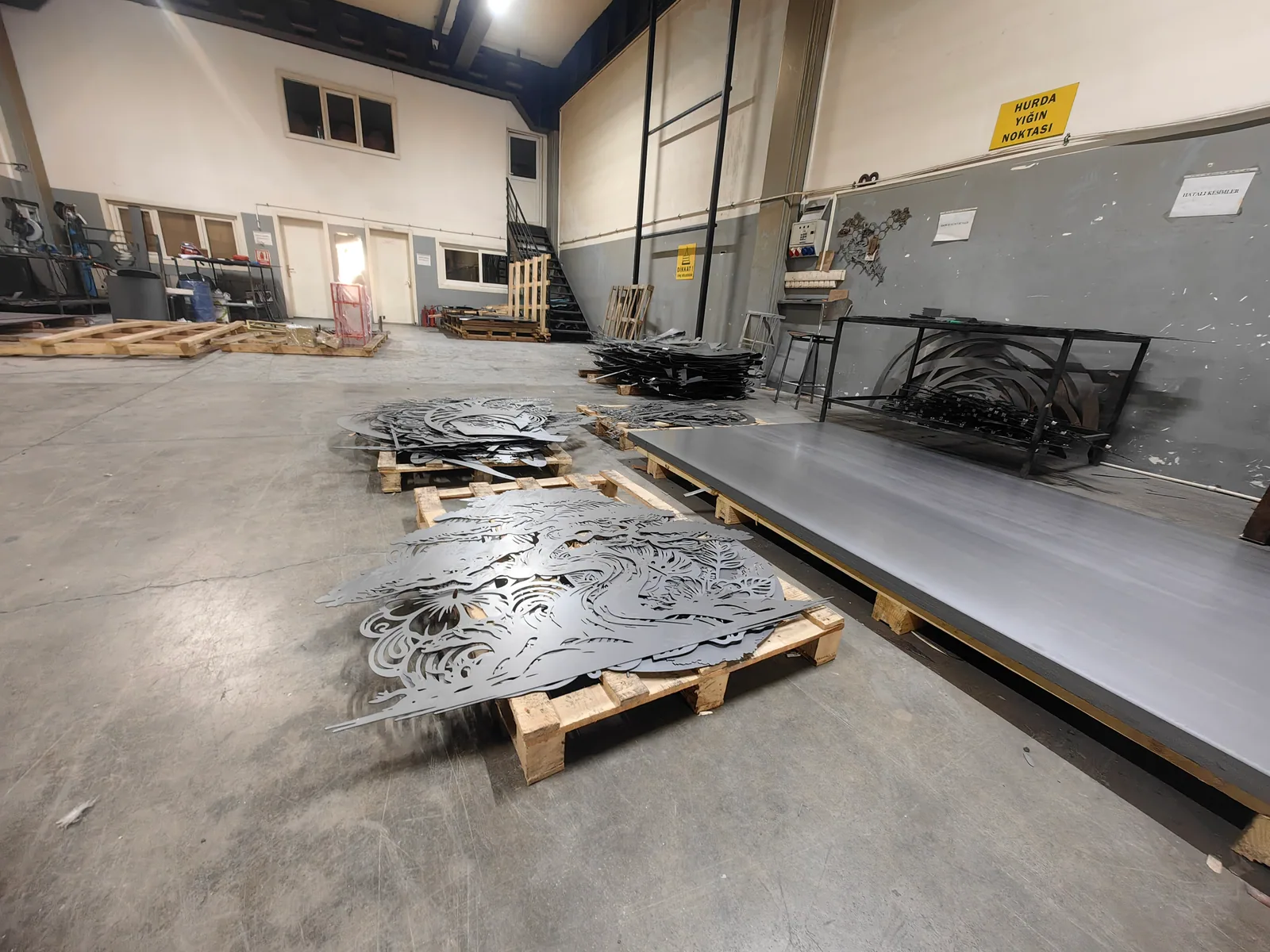
What they generally do not do is cut. Laser cutting is a fabrication process, not a printing process: it needs a machine that cuts steel, a powder coating line and a way to judge whether a given file can survive being cut at a given size. That is a workshop, not a print network, which is why cut-metal listings on those platforms are rare.
Where we fit
- What we make
- Laser-cut 1.5 mm steel, powder coated, standoff-mounted, produced one order at a time from your own artwork.
- What we do not make
- Printed panels of any kind. If your design is a photograph or a full-colour illustration, we are the wrong supplier and will say so.
- Manufacturability check
- Every file is analysed before you can order: thinnest metal, narrowest gaps, detached pieces, and the smallest size at which the design still holds together. Free, and it runs before payment.
- Blind shipping
- No brand name on the label or the box — not ours, not yours. Sent DDP so your buyer is not charged duties on delivery.
- Order sync
- Manual today. This is the clearest gap versus the large networks: you enter each Etsy sale here yourself. We have applied for Etsy's commercial API access.
- Commercials
- No subscription, no minimum order, no volume tiers. You pay per produced piece.
How to choose without wasting a month
- Look at your own artwork first. If it only works in full colour, the decision is already made — use a printing route.
- If your work is silhouette, line, lettering or geometry, printing it on a rectangle throws away the effect that makes it sell. That is the case for cut steel.
- Weigh automation honestly. A print network syncs orders for you; we do not yet. If you ship high volume and cannot spare manual order entry, that matters more than the product difference.
- Test with one design and one sample rather than a whole collection. Every supplier looks fine until a real piece is in your hands.
Frequently asked
Is laser-cut steel more expensive than a printed metal panel?+
It is a different product with a different cost base — steel, powder coating and a much heavier parcel. What that means for your margin depends on size, destination and the price you set, which is why the portal quotes each design individually rather than publishing a table.
Can I use the same artwork for both routes?+
Rarely. A file that prints beautifully as a full-colour image usually cannot be reduced to a single-colour cut outline, and a design built for cutting tends to look sparse printed on a rectangle. In practice they are separate products.
Do you integrate with Etsy or Shopify?+
Not automatically today. Orders are entered in the portal by hand and tracking numbers are copied back to the platform. We have applied for Etsy's commercial API access; if it is granted we will look at automatic sync.
Can I use you alongside another POD supplier?+
Yes, and many sellers should. Nothing here is exclusive — run your printed products through a print network and send only the cut-metal designs to us.
Upload the file. The analysis tells you whether it can be cut, and at which sizes, before you commit to anything.